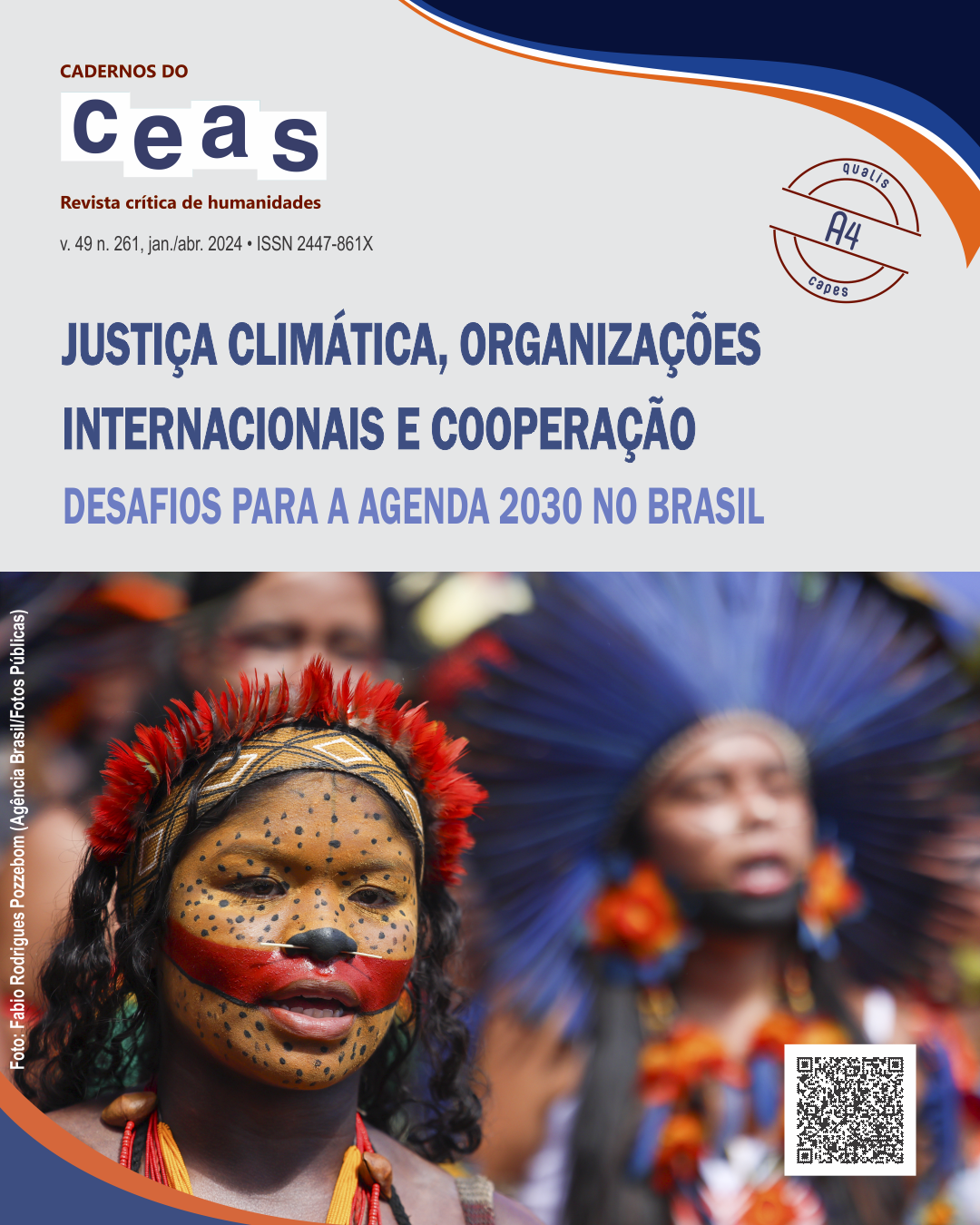
Climate change and gender: displacements from the 2nd March of Indigenous Women
DOI:
https://doi.org/10.25247/2447-861X.2024.n261.p178-200Keywords:
Climate change, Gender, Indigenous women, Climate governance, Feminist political ecology, Climate ecogovernmentalityAbstract
In this article, we narrate elements of our participation in the II March of Indigenous Women, held in Brasília in 2021, as part of research that investigates the intersections between climate change and gender. From an intersectional feminist perspective, we aim to reflect on the role of Indigenous women in climate governance and question the technoscientific and neoliberal approaches that dominate institutional spaces. We employ ethnography and feminist political ecology as our methodological framework, incorporating the concept of "border" by Gloria Anzaldúa to reflect on our positioning as non-Indigenous researchers entering a space created by and for Indigenous women. By discussing the institutional aspects of transnational climate governance, we articulate Astrid Ulloa’s concept of "Climate Ecogovernmentality" and engage in an epistemological and ontological debate to present alternative ways of interacting with nature, contrasting with the dominant Western technoscientific rationality in climate policies. We also address the intersections between gender and climate change, analyzing the role of Indigenous women’s movements and their critical contributions. Finally, we offer an ethnographic account of our participation in the II March of Indigenous Women, drawing from ethnographic inspirations to discuss the shifts this experience provoked in our research process. The encounter with Indigenous women led us to rethink the institutional and epistemological structures that guide the climate debate, opening paths for new forms of resistance and political action, based on care for the Earth and alliances between different knowledge systems.
Downloads
References
ARTICULAÇÃO NACIONAL DAS MULHERES GUERREIRAS DA ANCESTRALIDADE (ANMIGA). II Marcha das Mulheres. [S.l.], 2021. Disponível em: https://anmiga.org/marcha-das-mulheres/
ANZALDÚA, G. Borderlands/La Frontera: The New Mestiza. 1. ed. San Francisco: Aunt Lute, 1987.
ANZALDÚA, G. La conciencia de la mestiza: rumo a uma nova consciência. Revista estudos feministas, v. 13, p. 704–719, 2005.
ARORA-JONSSON, S. Forty years of gender research and environmental policy: Where do we stand? Women’s Studies International Forum, v. 47, p. 295–308, nov. 2014.
BERNARDINO-COSTA, J.; GROSFOGUEL, R. Decolonialidade e perspectiva negra. Sociedade e Estado, v. 31, p. 15–24, 2016.
BLÁZQUEZ SÁNCHEZ, O. La frontera y la decolonialidad. Una reflexión desde los feminismos-otros. Oficina do CES, n. 443, p. 1–8, 2018.
CRUTZEN, P. J.; STOERMER, E. F. The Anthropocene. v. 41, p. 17–18, 2000.
DA CUNHA, M. C. Relações e dissensões entre saberes tradicionais e saber científico. Revista USP, n. 75, p. 76–84, 2007.
DE LA CADENA, M. Protestando desde lo incomún. Em: SANTISTEBAN, R. S. (Ed.). Mujeres Indígenas frente al Cambio Climático. Lima, Perú: Grupo Internacional de Trabajo sobre Asuntos Indígenas, 2019. p. 35–48.
DE LA CADENA, M. D. L. Natureza incomum: histórias do antropo-cego. Revista do Instituto de Estudos Brasileiros, n. 69, p. 95–117, 27 abr. 2018.
DE LA CADENA, M.; KRENAK, A. Diálogo de abertura: Políticas cósmicas. . Em: SERES-RIOS FESTIVAL. 2 ago. 2021. Disponível em: <https://www.youtube.com/watch?v=JPWjlZcOoe0>. Acesso em: 4 ago. 2021
DENTON, F. Climate change vulnerability, impacts, and adaptation: Why does gender matter? Gender & Development, v. 10, n. 2, p. 10–20, jul. 2002.
ELMHIRST, R. Introducing new feminist political ecologies. Geoforum, v. 42, n. 2, p. 129–132, mar. 2011.
ELMHIRST, R.; HIDALGO, M. G. Ecologías políticas feministas: perspectivas situadas y abordajes emergentes. Ecología Política, p. 50–57, 2017.
GALBIATI, L. A. et al. Emergências ecofeministas: Um estudo desde as práxis de coletivos de mulheres latino-americanas e caribenhas. Em: Feminismo y ambiente: un campo emergente en los estudios feministas de América Latina y el Caribe. Buenos Aires; Nueva York: ONU Mujeres : CLACSO, 2022. p. 201–268.
GROSSMANN, K.; HAUG, M. Gender and environmental change: recent debates and new perspectives in anthropological research. Antropologia, v. 5, n. 1 N.S., p. 7–21, 28 mar. 2018.
HARAWAY, D. Situated knowledges: The science question in feminism and the privilege of partial perspective. Feminist studies, v. 14, n. 3, p. 575–599, 1988.
HARAWAY, D. J. Staying with the trouble: Making kin in the Chthulucene. [s.l.] Duke University Press, 2016.
HULME, M. 2 How Climate Models Gain and Exercise Authority. Em: The social life of climate change models. [s.l.] Routledge, 2012. p. 30–44.
INGOLD, T. Chega de etnografia! A educação da atenção como propósito da antropologia. Educação, v. 39, n. 3, p. 404–411, 2016.
JASANOFF, S. Knowledge for a just climate. Climatic Change, v. 169, n. 3–4, p. 36, dez. 2021.
LATOUR, B. Diante de Gaia: oito conferências sobre a natureza no Antropoceno. 1a ed. [s.l.] Ubu Editora, 2020.
MACGREGOR, S. ‘Gender and climate change’: from impacts to discourses. Journal of the Indian Ocean Region, v. 6, n. 2, p. 223–238, dez. 2010.
MACGREGOR, S. (ED.). Routledge handbook of gender and environment. London ; New York: Routledge, Taylor & Francis Group, 2017.
MARCHA MUNDIAL DE LAS MUJERES (MMM). No al capitalismo verde: um llamado de las mujeres a la resistência. MMM, , 2019.
MELLOR, M. Feminismo y ecología. 1a ed. en español ed. México, D.F.: Siglo Veintiuno Editores, 2000.
MIES, M.; SHIVA, V. Ecofeminism. [s.l.] Zed books, 1993.
MIGNOLO, W. D. Histórias locais-projetos globais: colonialidade, saberes subalternos e pensamento liminar. [s.l.] Ed. ufmg, 2003.
MIGUEL, J. C. H.; MAHONY, M.; MONTEIRO, M. S. A. A “geopolítica infraestrutural” do conhecimento climático: o Modelo Brasileiro do Sistema Terrestre e a divisão Norte-Sul do conhecimento. Sociologias, v. 21, p. 44–75, 2019.
MOL, A. P. J. Ecological modernization: industrial transformations and environmental reform’in Redclift, M., Woodgate, G.(eds.). Em: REDCLIFT, M. R.; WOODGATE, G. (Eds.). The International Handbook of Environmental Sociology. [s.l.] Edward Elgar Publishing Limited, 1997.
MOL, A. P. J. The environmental movement in an era of ecological modernisation. Geoforum, v. 31, n. 1, p. 45–56, fev. 2000.
ORTEGA, M. In-between: Latina feminist phenomenology, multiplicity, and the self. [s.l.] SUNY press, 2016.
PLUMWOOD, V. Dualism: the logic of colonisation. Em: PLUMWOOD, V. (Ed.). Feminism and the mastery of nature. Digital printing ed. London: Routledge, 2003. p. 41–68.
PRIETO, L. P. Epistemología feminista y conocimientos desde el Sur global. Ecología Política, p. 12–15, 2017.
SANTOS, A. B. DOS. Colonização, quilombos: modos e significações. Brasília: INCTI/UnB, 2015.
SCOTT, J. W. Gender: A Useful Category of Historical Analysis. The American Historical Review, v. 91, n. 5, p. 1053, dez. 1986.
SILIPRANDI, E. (ED.). Género, agroecología y soberanía alimentaria: perspectivas ecofeministas. Primera edición ed. Barcelona: Icaria Editorial, 2014.
STENGERS, I. No tempo das catástrofes. 1a ed. [s.l.] Cosac & Naify, 2015.
SVAMPA, M. Feminismos del Sur y ecofeminismo. Nueva Sociedad, n. 256, p. 127, 2015.
SVAMPA, M. Feminismos ecoterritoriales en América Latina. Entre la violencia patriarcal y extractivista y la interconexión con la naturaleza. Documentos de trabajo (Fundación Carolina): Segunda época, n. 59, p. 1, 2021.
TSING, A. L. O antropoceno mais que humano. Ilha Revista de Antropologia, v. 23, n. 1, p. 176–191, 24 fev. 2021.
ULLOA, A. Políticas globales del cambio climático: nuevas geopolíticas del conocimiento y sus efectos en territorios indígenas. Perspectivas culturales del clima, p. 477–493, 2011.
ULLOA, A. Producción de conocimientos en torno al clima. Procesos históricos de exclusión/apropiación de saberes y territorios de mujeres y pueblos indígenas. Working Paper Series, v. 21, 2012.
ULLOA, A. The geopolitics of carbonized nature and the zero carbon citizen. South Atlantic Quarterly, v. 116, n. 1, p. 111–120, 2017.
ULLOA, A. La confrontation d’un citoyen zéro carbone déterritorialisé au sein d’une nature carbonée locale-mondiale. Em: Penser l’anthropocène. Paris: Presses de Sciences Po, 2018. p. 283–300.
ULLOA, A. Ecología política feminista latinoamericana. A. De Luca, E. Fosado y M. Velázquez (Coords.), Feminismo socioambiental Revitalizando el debate desde América Latina. Cuernavaca: UNAM-CRIM, 2020.
VAN DER HEIJDEN, H. Environmental movements, ecological modernisation and political opportunity structures. Environmental Politics, v. 8, n. 1, p. 199–221, mar. 1999.
Downloads
Published
How to Cite
Issue
Section
License

This work is licensed under a Creative Commons Attribution 4.0 International License.
Autores que publicam nesta revista concordam com os seguintes termos:
- Autores mantém os direitos autorais e concedem à Cadernos do CEAS o direito de primeira publicação, com o trabalho simultaneamente licenciado sob a Licença Creative Commons Attribution que permite o compartilhamento do trabalho com reconhecimento da autoria e publicação inicial nesta Revista.
- Autores têm autorização para assumir contratos adicionais separadamente, para distribuição não-exclusiva da versão do trabalho publicada nesta revista (ex.: publicar em repositório institucional ou como capítulo de livro), desde que reconheça e indique a autoria e a publicação inicial nesta Revista.
- Autores têm permissão e são estimulados a publicar e distribuir seu trabalho online (ex.: em repositórios institucionais ou na sua página pessoal) a qualquer momento depois da conclusão de todo processo editorial, já que isso pode gerar alterações produtivas, bem como aumentar o impacto e a citação do trabalho publicado (Veja O Efeito do Acesso Livre).